
Plantation shutters
Shutters are the window furnishing that becomes part of the window. Framed panels, adjustable louvres, and a structured finish that changes how a room reads rather than just covering the glass.
Tilt the louvres and you change the balance between daylight, privacy and airflow without moving anything. Because shutters are made to one opening, your local Andersens can work through configuration, material, louvre size and finish with you, then measure and quote your own windows.
Custom made, professionally installed
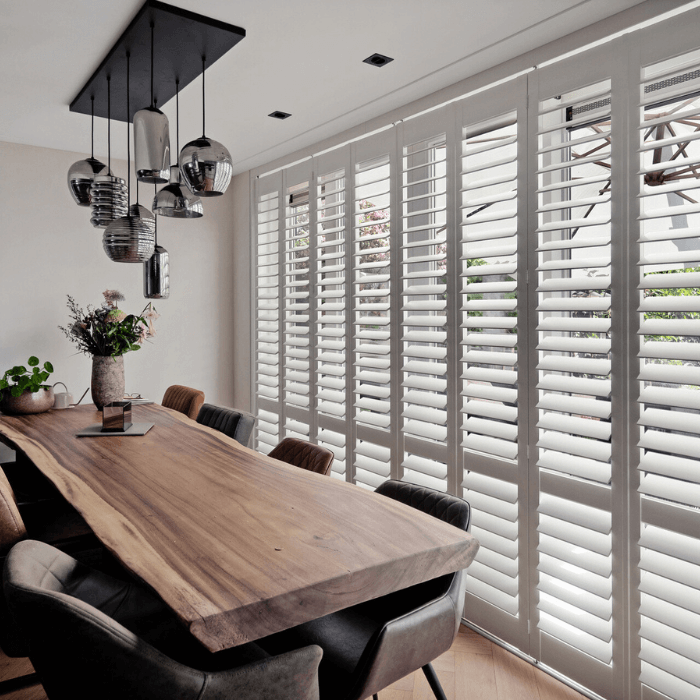
Find your way in
What a plantation shutter is
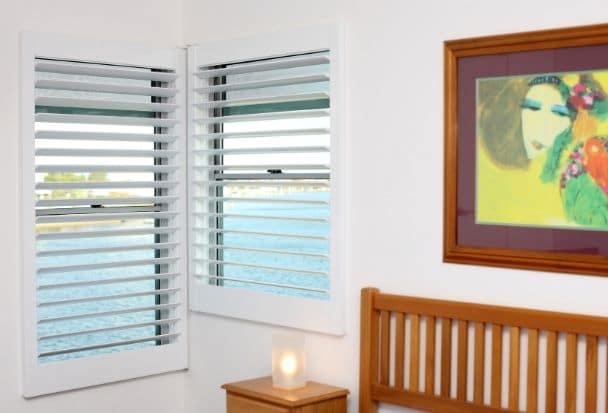
A plantation shutter is a rigid framed panel holding a stack of adjustable horizontal louvres. Most people use “shutters” and “plantation shutters” interchangeably, and in a house they usually mean the same thing: interior shutters with louvres you can tilt.
-
The louvres do the work
Rotating the louvres changes how daylight enters the room, how much of the view you can see, how much anyone outside can see in, and how much air moves through with the window open. It is one control doing four jobs.
-
The panels open too
Shutters are hinged in the window opening, so the panels can be opened away from the glass for full access to the window. That is worth knowing if you need to reach a handle, a lock or a flyscreen.
-
There is a frame around it
Unlike a blind or a curtain, a shutter is framed into or around the opening. That is where the architectural look comes from, and it is also why fit is so visible on a shutter and forgiving on a curtain.
-
No cords
Interior shutters have no hanging strings or cords, which Andersens’ own shutter guidance points to as a safety benefit in homes with small children.
| Consideration | Plantation shutters |
|---|---|
| Construction | Framed panels holding adjustable horizontal louvres |
| Appearance | Structured, and reads as part of the window rather than a covering over it |
| Light control | Adjusted by tilting the louvres, from open through to closed |
| Privacy | Adjustable, and can be set to screen the view while still letting light in |
| Airflow | Can be kept with the window open and the louvres angled |
| Window access | Panels can be opened where the configuration allows it |
| Cleaning | Hard surfaces, usually dusted and wiped rather than laundered |
| Fit | Custom measured to the opening |
| Worth considering for | Bedrooms, living and dining areas, studies, feature windows, and kitchens and bathrooms where the product suits the room |
Light, privacy and the look of the room
Work out what the window has to do before you look at finishes. Almost every shutter decision after this one gets easier once you know whether you are solving for glare, for privacy, for airflow or for the way the room looks.
Adjustable light control
Tilt the louvres and you can take direct sun and let it in, break it up and diffuse it, cut glare off a screen or a television, or close the louvres for much stronger control. Andersens’ own shutter guidance describes light being filtered in different ways by rotating the louvres to different angles.
Privacy you can dial in
This is where shutters differ most from fabric. You do not have to cover the window to get privacy. Opening the louvres slightly screens the view while daylight and air still come through, which is useful on street-facing bedrooms, living rooms, home offices and any window close to a neighbour.
Airflow with the window open
With the window open and the louvres angled, air moves through while the room stays screened. How much depends on the louvre angle, the type of window and the configuration, so it is not a fixed quantity, but it is a real advantage of a louvred product over a solid one.
An architectural finish
A shutter reads as part of the window rather than something hung in front of it. That suits contemporary rooms, coastal and Hamptons-influenced interiors, traditional homes, transitional interiors and renovations, which is a large part of why the look has stayed in use for so long.
A hard surface to look after
There is no large area of hanging fabric. Shutters are generally dusted or wiped according to the care guidance for the product, which is a practical difference in kitchens, dining rooms and anywhere that collects cooking residue.
Design that stays put
Shutters have been used across a broad range of interiors for a long time, so a shutter is less likely to date than a more fashion-led treatment. That is a design point rather than a financial one, and this page makes no claim about what shutters do to the value of a house.
Worth being clear about. Closing the louvres gives you strong light control, but it does not make a room dark. Light still enters through the louvre joins, the gaps between panels, the frame edges and around the hinges. Shutters do add a physical layer at the window, but any thermal effect depends on the product, the fit, the glazing and the installation, so ask what a specific product does rather than what shutters do. Suitability for a bathroom, a laundry or any other wet area is a property of the individual product, never of shutters in general.
How the shutter is divided up
How a shutter is split across the window matters as much as what it is made from. It decides how much privacy you get and where, whether you can still open the window, and how the whole thing looks when it is closed.
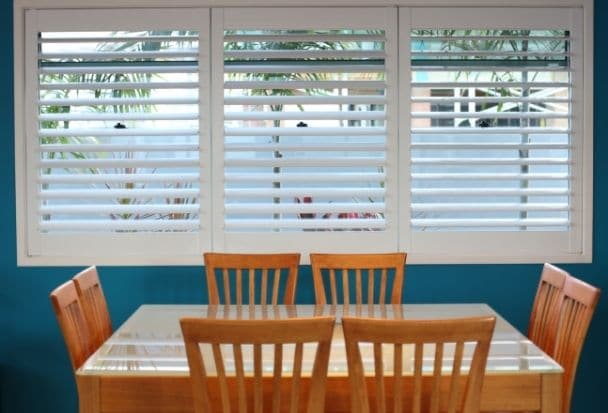
Full height
The most common
One run of panels covering the whole opening, top to bottom. Consistent to look at, and gives you louvre control across the full window.
Worth considering for bedrooms, living and dining rooms and larger windows.

Cafe style
Lower window only
Panels across the bottom of the window with the top left uncovered. Screens the view at standing and seated eye level while daylight keeps coming through the upper glass.
Often the answer on a street-facing living or dining window.
Tier on tier
Two independent sections
Separate upper and lower panels that open and tilt independently, so you can have privacy below and light above, then open the lot for full access.
Availability depends on the product, so ask at the measure.
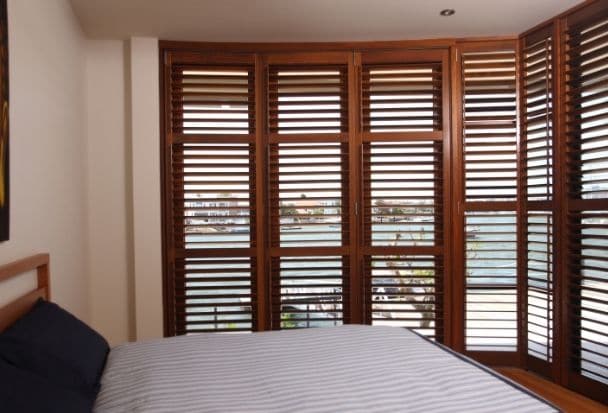
Hinged and folding panels
Wider openings
Panels hinged to each other so they fold back together. A way of clearing a wider opening without a single panel that is too big to handle.
Panel weight and hinge clearance both matter here.

Tracked and sliding panels
Doors and long runs
Panels running on a track rather than swinging on hinges, which is one way of handling a sliding door or a long glazed wall.
Systems and maximum sizes vary, so confirm what suits your opening.
How many panels
A wide opening might be two panels, four, or a folding set. The right answer balances how it looks, what each panel weighs, whether the window underneath still opens, how the louvres line up across the panels, and where the panels go when they are open.
Divider rails and alignment
Some designs put a horizontal rail across the panel so the louvres above and below can be set separately. Across a run of adjoining windows, keeping the rails and louvres lined up is what makes the finished job look considered rather than assembled.
Availability varies. Full height and cafe style are the two arrangements Andersens’ published shutter guidance describes. Tier on tier, folding panels and tracked or sliding systems exist in the shutter market, but which of them your local store can supply, and the maximum panel sizes they run to, depends on the product. Ask at the measure rather than planning a wide opening around a system that may not be available for it.
Not sure how your windows should be divided?
What shutters are made from
Material affects the look, the weight, how the shutter handles moisture, how it is cleaned and what it costs. These are the categories used across the shutter market rather than a list of what is in stock, because ranges and manufacturer terminology differ from store to store.
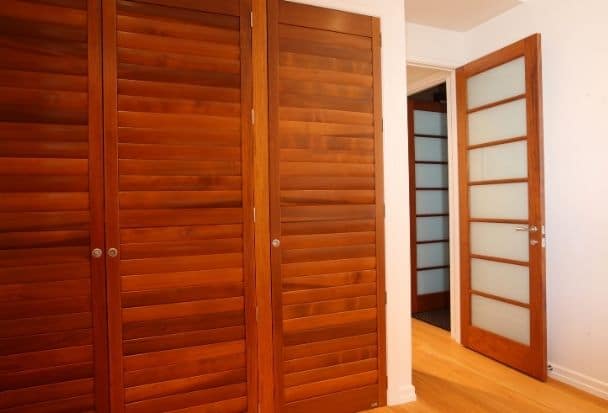
Natural timber
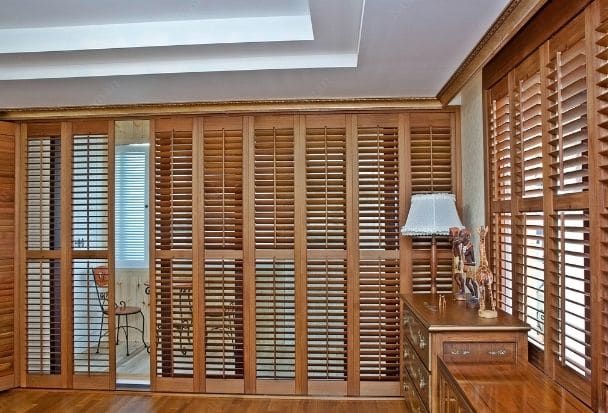
Real grain, and the material to look at if you want a stained finish that ties in with timber floors or joinery. Weight, finish and colour consistency are all worth asking about, and timber should not be specified for a humid room without checking the product guidance first.

Polymer, PVC and composite
Manufactured materials, often chosen where moisture or simple cleaning matters more than natural grain. Composites vary a great deal between makers, so the useful question is what a specific product is rated for rather than what the material category generally does.
A photograph cannot tell you what a white shutter is made from, which is why this page describes materials rather than labelling images with them.
| Material | Natural material | Visible grain | Moisture-prone rooms | Finishes |
|---|---|---|---|---|
| Natural timber | Yes | Genuine, and visible in a stained finish | Confirm per product before specifying it for a humid room | Painted or stained, subject to the range |
| Polymer or PVC | No, manufactured | Simulated where a grain appears at all | Often the material chosen for moisture-prone rooms, subject to the product | Usually painted finishes, subject to the range |
| Composite | Manufactured, often with a timber component | Depends on the product | Depends on the product, and varies a lot between makers | Depends on the range |
Ask about the product, not the material. Moisture performance belongs to an individual product, not to a material category, so no shutter should be assumed suited to a wet area until its specification says so. Which materials your local Andersens carries, what each one is approved for, and what the manufacturer calls it are all worth confirming before you choose one for a bathroom, a laundry or a kitchen window near a sink.
Choosing the finish
Andersens’ shutter guidance describes interior shutters as available in paint or stain colours to suit the room. These are directions rather than rules, and what you can actually order depends on the material and the range at your local store.
| Finish | What it tends to suit | Worth knowing |
|---|---|---|
| White | The most common choice. Works with white frames and architraves, light walls, coastal and Hamptons-influenced rooms and contemporary interiors. | Whites are not interchangeable. Hold the sample against the architrave, the wall paint and the cabinetry before you settle on one. |
| Warm white and cream | Sits comfortably with warm timber floors, beige carpet, cream walls, natural stone and more traditional rooms. | A cool white beside warm flooring can read grey. This is the fix. |
| Grey and cooler neutrals | Suits contemporary rooms and cooler palettes, and can be a way of not matching the architrave exactly. | Check it in artificial light as well. Cool neutrals move a lot under warm globes. |
| Stained and timber-look finishes | Where the range offers them, a stained finish connects the window with timber flooring, joinery and furniture. | Not every material takes a stain, so ask what is possible before you plan a room around it. |
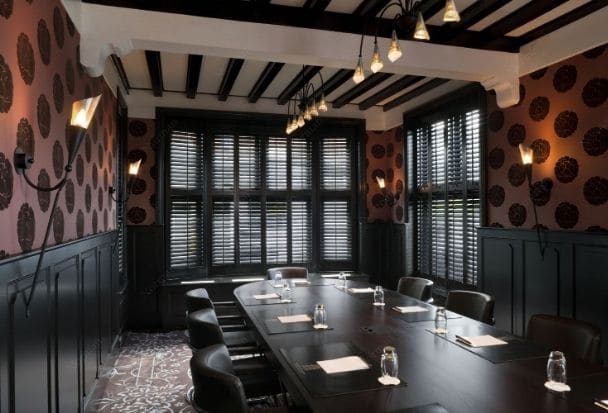
| Dark and near-black finishes | A deliberate contrast against light walls, and a strong architectural look in a kitchen or a feature window. | Dark finishes show dust and fingerprints more readily than white. Worth knowing before you choose one for a kitchen. |
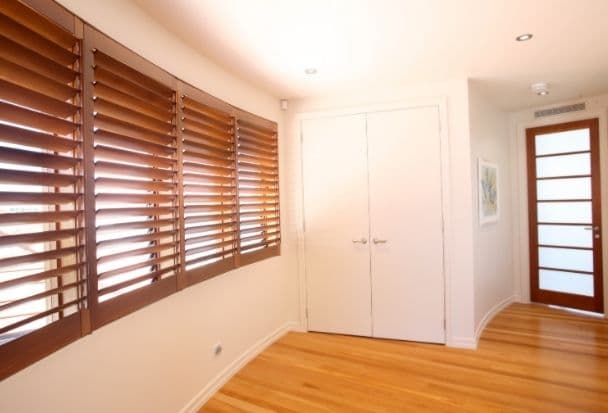
Coordinating with your floor
Shutters do not have to match the flooring, and trying to match exactly usually looks worse than coordinating undertones. Warm timber floors sit well with warm whites. Pale oak-look floors take a soft neutral. Dark timber is often better balanced by a lighter shutter than echoed by a dark one. Neutral carpet will carry either.

Look at samples properly
Finish is the easiest thing on this page to get wrong from a photograph, because a shutter sits right next to the architrave and the window frame. See the sample in the room it is going in, beside the frame, against the wall paint and next to the flooring, in morning light, in afternoon light and under the lights you use at night.
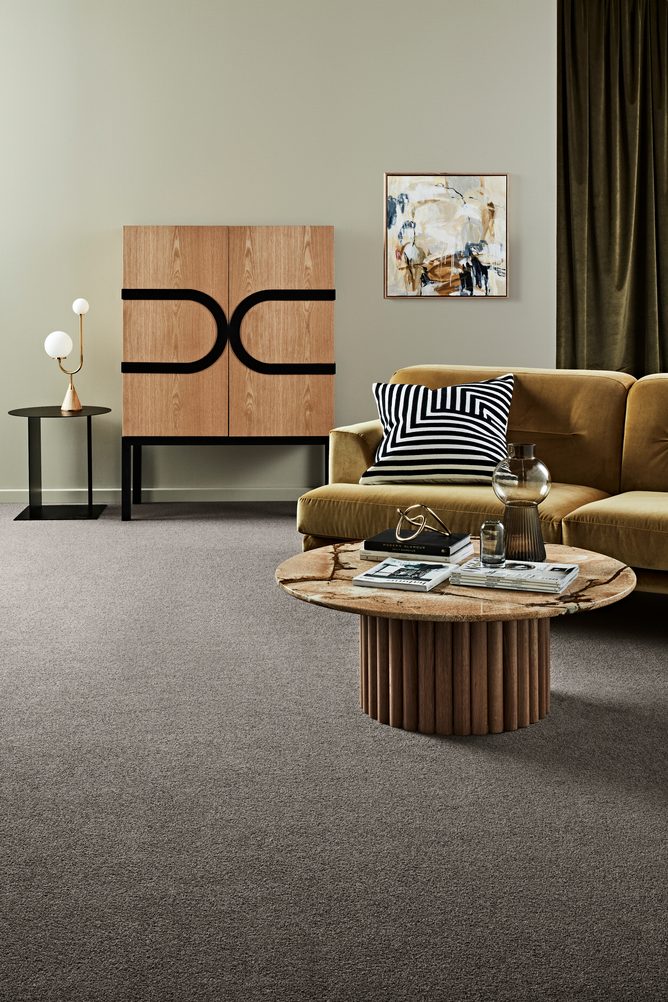
Find the perfect fit for your home.
Whether you are renovating a single room or updating your entire home, discover quality flooring and window furnishings for every style, space and budget.
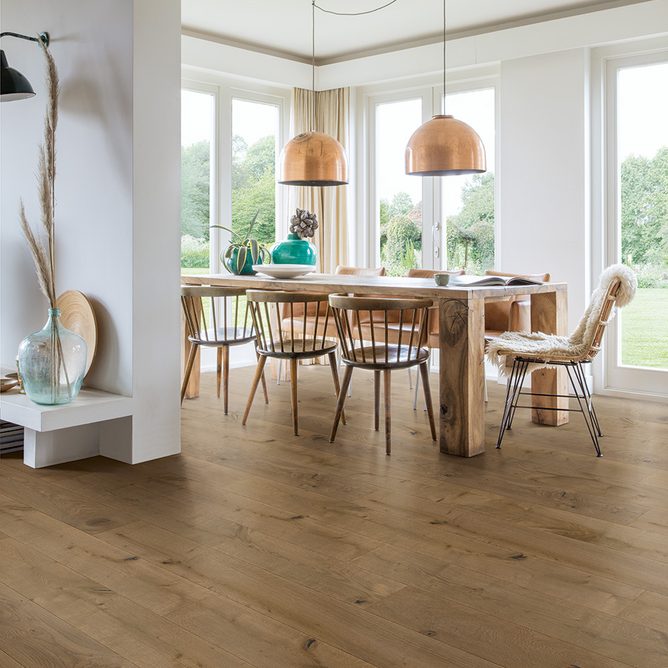
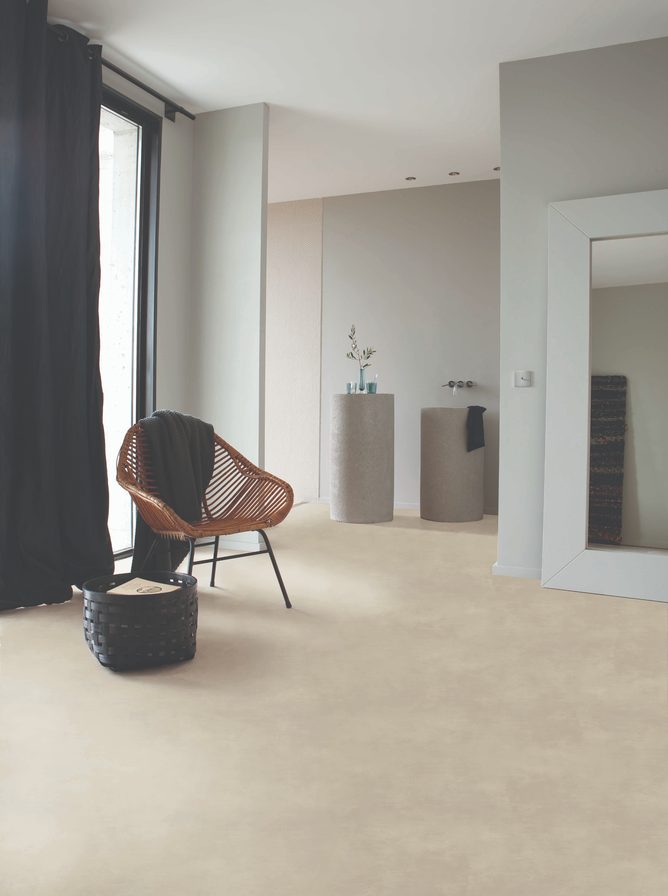
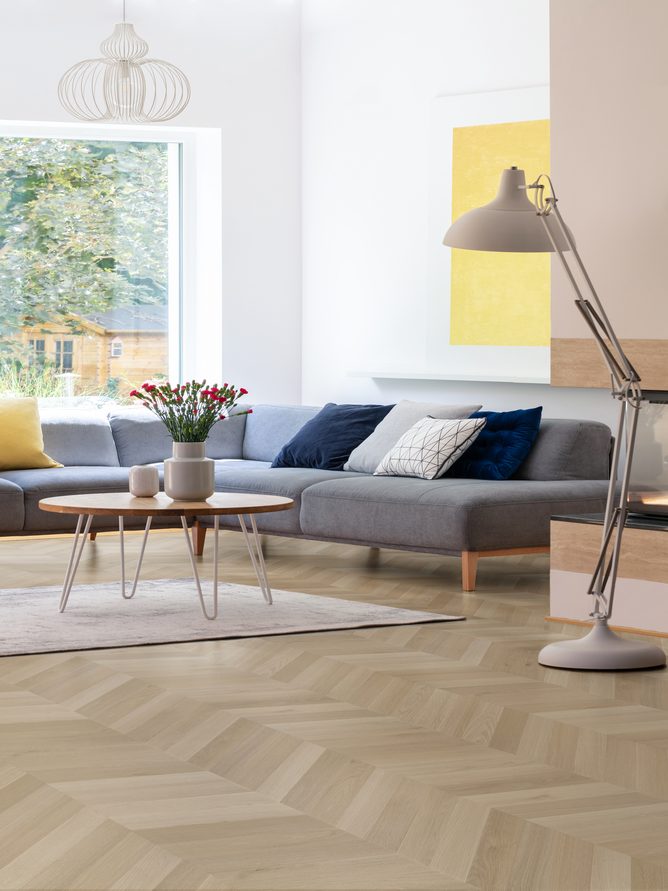
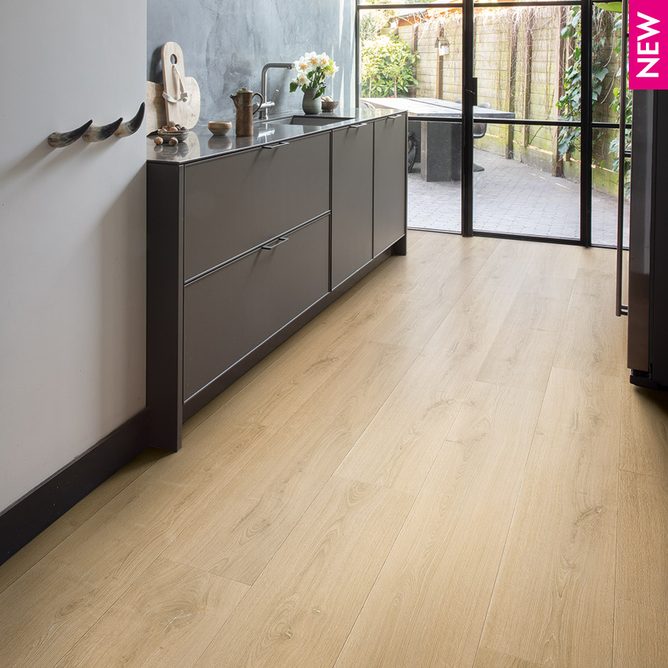
Find shutters near you
Shutters are much easier to choose in person, because louvre width, frame profile and the exact white are all things you judge by eye. Selected Andersens stores carry shutters as part of their window furnishings range, so ranges and services vary from store to store. Visit your local showroom to see what is available, talk through configurations, materials, louvre sizes and finishes, and find out which window furnishing services are offered in your area. It is worth calling ahead.
Search by suburb or postcode
Find your nearest Andersens and its opening hours, or arrange a measure and quote for your windows.
Keep looking
Key benefits of interior shutters
Andersens on light control, window access, privacy and cord-free operation.

How to clean your window coverings
The step-by-step method for shutters and every other type of covering.
Window blinds
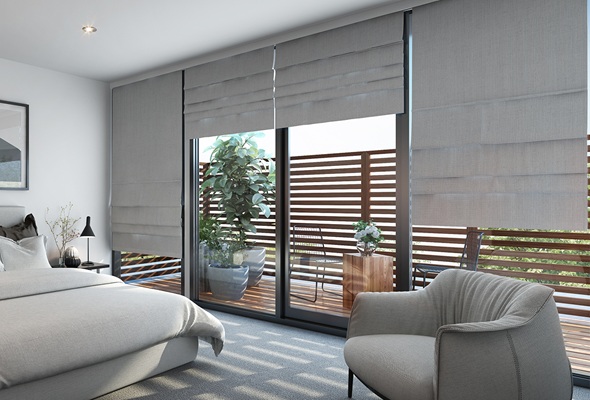
Roller, roman, panel, venetian and vertical blinds, and how they compare.

Curtains
Fabric, softness and floor-to-ceiling styling, on their own or layered over shutters.
Windows and floors, in one conversation

Seen in your own light
A free, no-obligation in-home measure and quote means you can hold finishes against your own window frames, walls, flooring and furniture, in the light the room actually gets.
Made for your opening
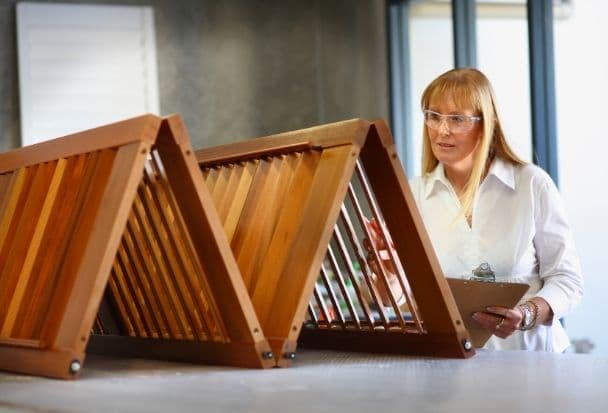
Andersens states that its window furnishings orders are custom-made and professionally installed. On a framed product that matters, because the fit is the part you look at every day.
The whole room, not one surface
Shutter finish has to work with the floor, the walls and the light. Choosing windows in the same place as your flooring is the practical version of that.